Guide › After a run
After a run
Reading a run
Every run read the way a coach would: what it was, how you ran it, and what it says about your fitness.
Runs and one run
Every run you have done, one tap away.
- Filter by type; sort by load, pace, Heart-rate drift or distance.
- Fastest distances: your best 1 km, 5 km, 10 km… found inside any run, not only races.
- Each row: workout type as a colour, any record medal, load, pace, heart rate, how well it held, time in zones.
- Compare types sets your four workout types side by side.
A training run
Did you run the session you were given, and was it a good one?
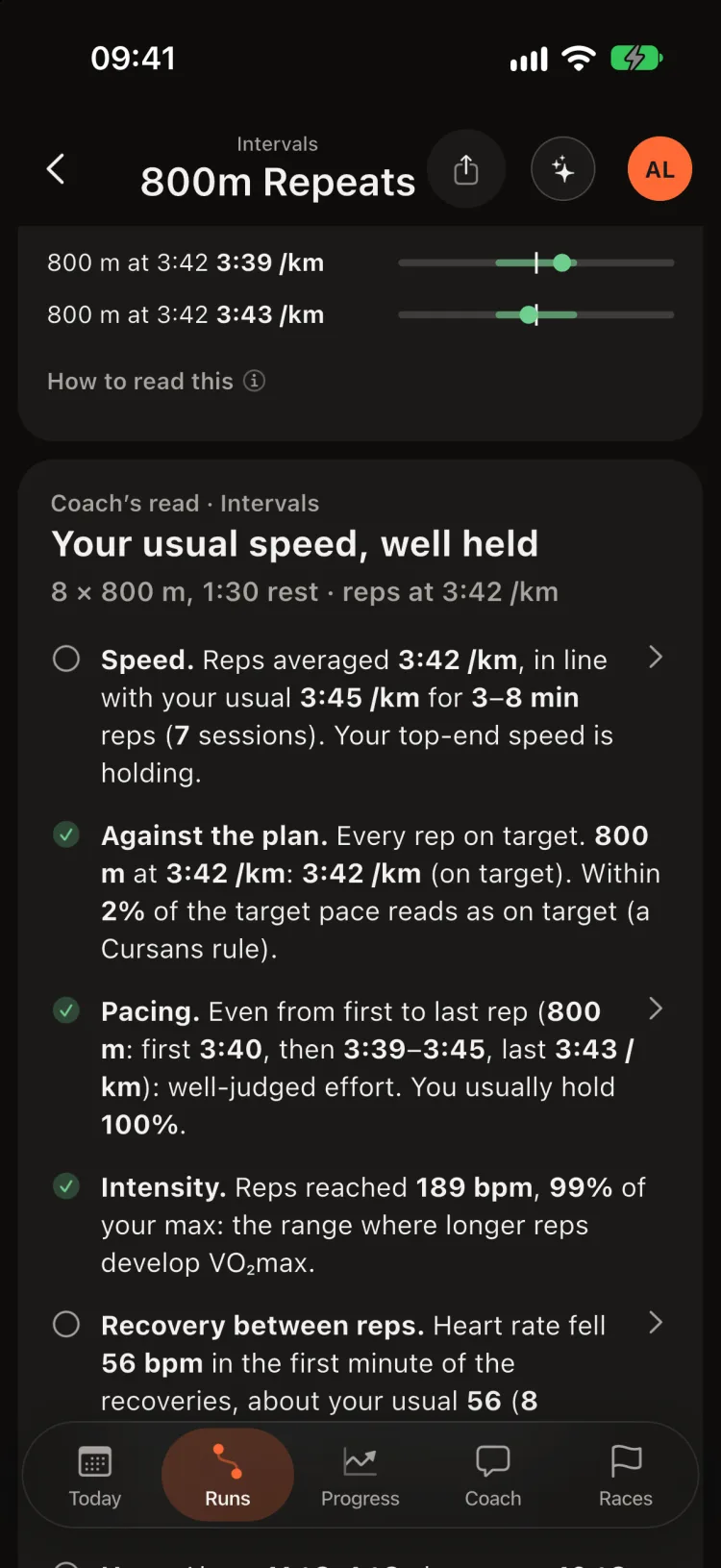
- Against the plan: every rep against the plan's target band, faster to the right.
- The coach's read: the session in one line, such as 3 × (1.2 km, 2:00 rest, 400 m, 60 s rest), then speed, pacing, intensity, recovery between reps and how you came in, each against your usual for that kind of session.
- Below: summary, route, streams, zones, durability by quarter, elevation, running mechanics, conditions and splits.
- The type at the top: every run gets one, and when Cursans is not sure it asks you once in Today's One question card. Tap it to change the type; your choice always wins.
Like against like: your 400 m reps against your 400 m reps, never against a tempo run.
More on a run's page
- Heart-rate drift: how much less speed each heartbeat bought in the second half than in the first. Up to 5% is steady (Friel 2009).
- Where drift starts, on long runs and races of an hour or more: the point after which heart rate climbs for good. Later and smaller is better (Smyth et al. 2022). A single run is described, never coloured.
- How you came in: that day's check-in, and how hard the run felt if you said so.
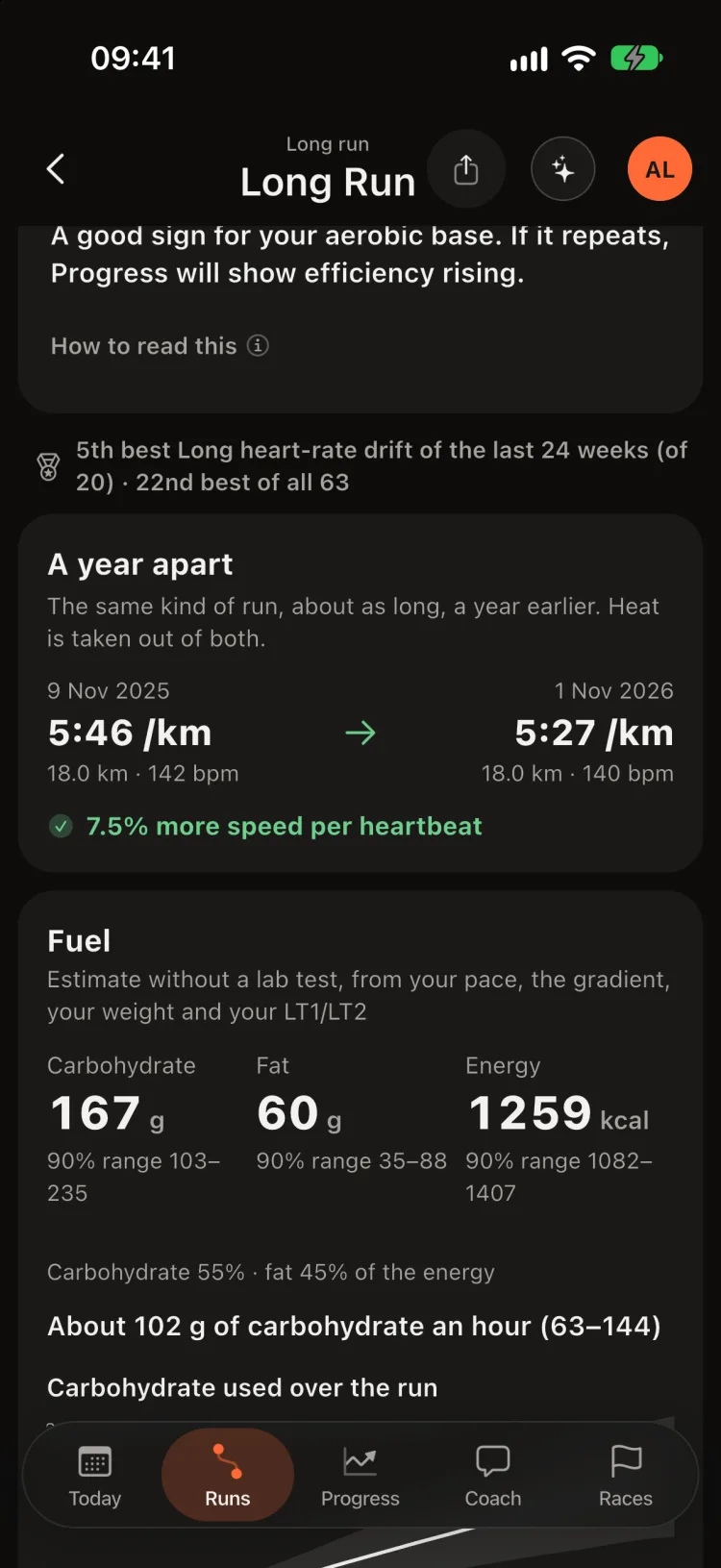
- Fuel, on long runs, races and runs of an hour or more: an estimate of the carbohydrate and fat the run used, as a likely range, never a verdict. Add what you took in the run (gels, sports drink and others) if you like.
- A step up in distance: a run more than 10% longer than your longest of the 30 days before gets a note with its size (Frandsen et al. 2025). It describes the step; it is not a diagnosis.
- A year apart, on training runs: the same kind of run, about as long, a year earlier, as speed per heartbeat, with the weather's part stated.
- Patchy heart rate? When the watch recorded only part of the run, Coach's read says so first, and the run is not judged on heart rate.
Session as written
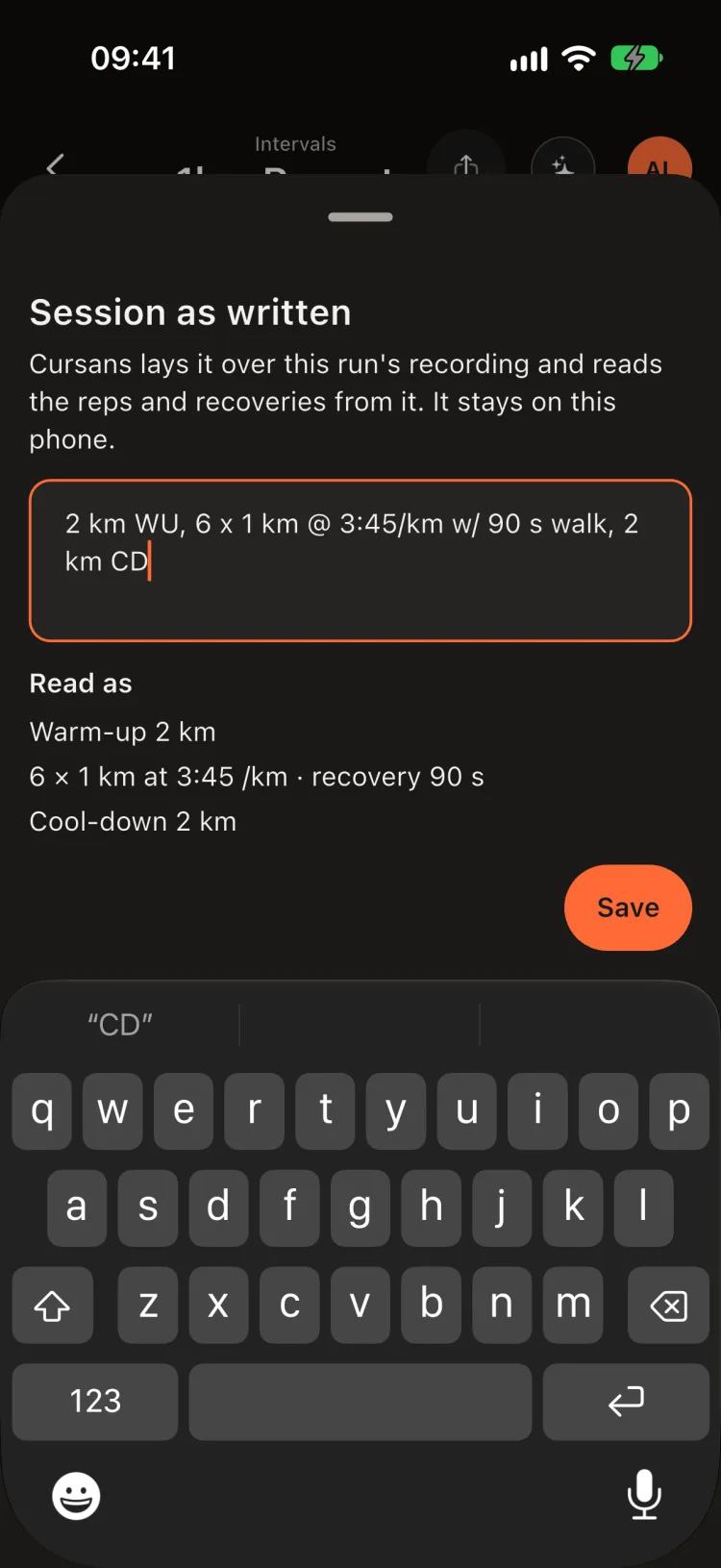
Got the session from a coach in a message or a spreadsheet? On the run's page tap Add the session as written and paste it, for example 2 km WU, 6 × 800 m @ 3:40/km w/ 90 s jog, 1 km CD. Cursans shows how it read it (Read as) before you save, then lays it over the recording and reads the reps and recoveries from it. It wins over a plan app's text and stays on your phone.
A race
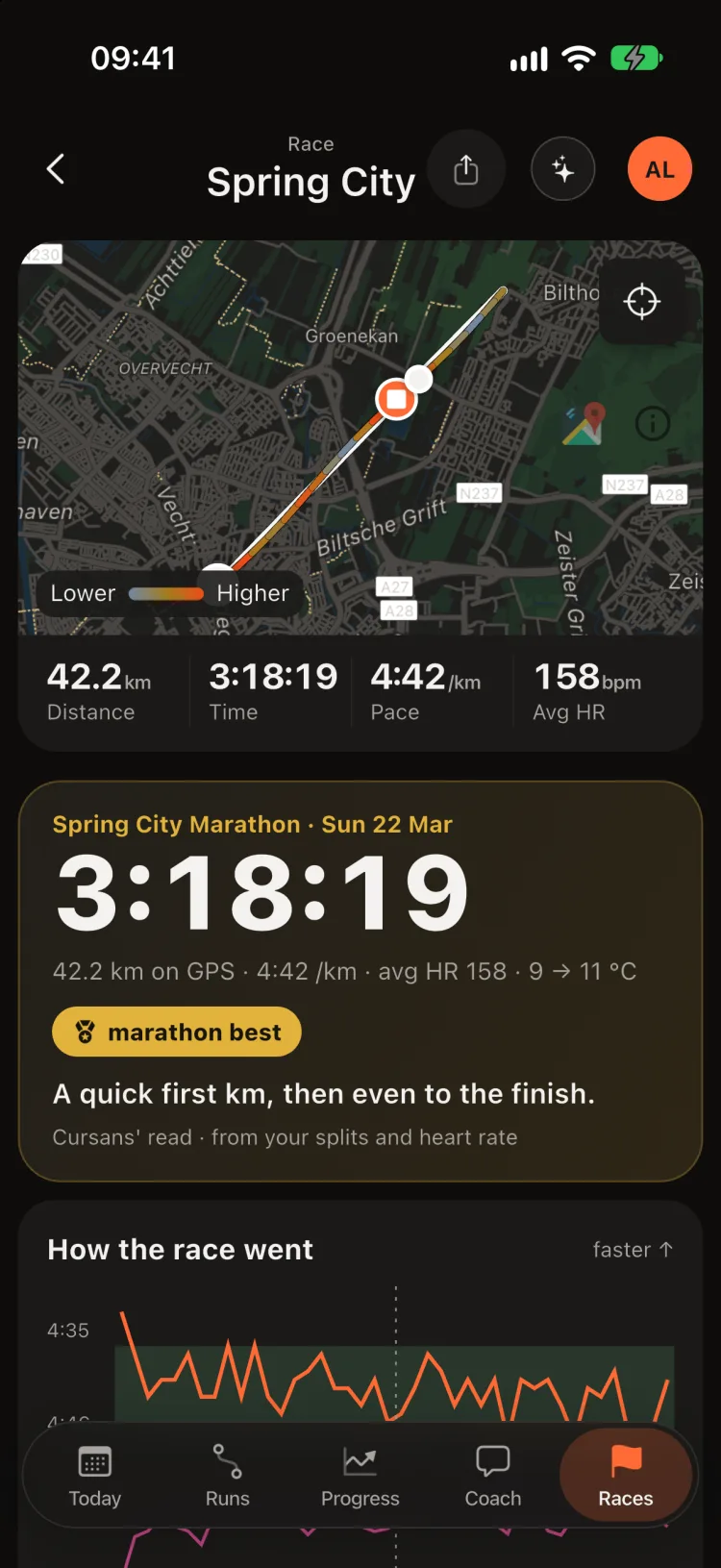
Your race, explained on one screen.
- The finish time, one badge (a best or a first) and one sentence on how it went.
- How the race went: your pace km by km inside a ±5 s band around race pace, heart rate underneath. Tap any km.
- Your marathons (or halves, 10Ks…): every race of the distance. A hollow dot was run at an easy heart rate, not raced.
- What the race says: keep, adjust and check, each with its evidence.
Faster at the same heart rate is fitness, not a braver day. The race page shows which one it was.